
The work responds to the history of St Martin-on-the-Hill, Scarborough, and the founder, Miss Mary Craven (1812 – 1889), a respected and substantial South Cliff citizen who generously provided most of the money to build the church.

The cyanotype dress is layered with a design connected to the medievalism of Pre-Raphaelite art and an unexpected story about Mary. The blue of the dress is specific to the photographic chemicals related to the cyanotype process. Blue is symbolic of heaven and is traditionally associated with the Virgin Mary.

I have been particularly drawn to the interpretation of white lilies in stained glass windows. They represent new life and symbolise both the sacrifice of Christ and the purity of the Virgin Mary. In Dante Gabriel Rossetti’s ‘The Annunciation’ on the pulpit, the artist illustrates the Angel Gabriel presenting lilies to the Virgin Mary as if they are a romantic gift. Miss Craven was clearly devoted to her religion and passionate about St Martin’s as a new place of worship – a romance (of sorts) with the church itself, perhaps!
I am very fond of an interesting tale about Mary that came to light in my research.
“When Miss Craven, a respected and substantial citizen of the South Cliff, who had provided most of the money to build St Martin’s Church, was caught ‘purloining flowers from the grounds’ she was threatened with proceedings if there was any repetition”. (The Book of Scarborough Spaw, by Meredith Whittaker)

Inspired by William Morris, the lower pattern of the dress refers to this story of 1870 – a clifftop walk through oak saplings, ground-creeping ivy, long grasses and wildflowers. A solitary house martin digitally captured from the church pulpit is taken from a design by Rossetti that alludes to the story of St Martin of Tours; this was Mary’s chosen name-saint for the church in memory of her late father, Robert Martin Craven. The bodice also includes a detail from a painting by Rossetti, ‘Sancta Lilias (Sacred Lily)’.

A few years ago, I discovered that I live in the former residence of Mary Craven. I often wonder if the Pre-Raphaelites, such as William Morris, Edward Burne-Jones, or Dante Gabriel Rossetti, visited Mary for afternoon tea. A nice thought!
I decided to construct the artwork at home instead of in the studio. Developing the project in her former abode was central to the project.

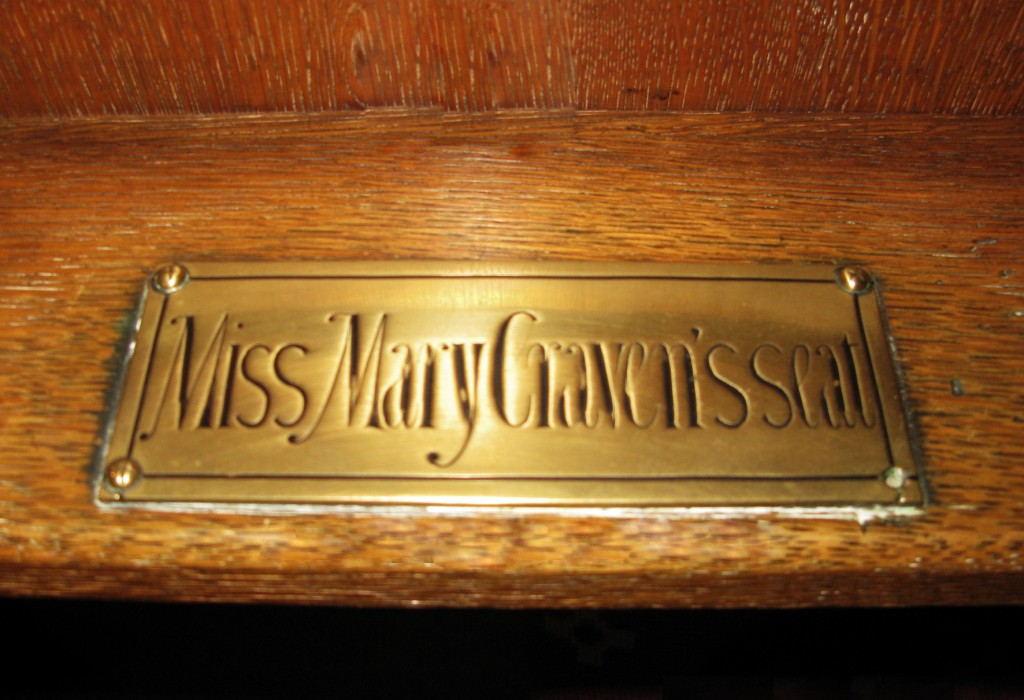
The spirit and generosity of Mary Craven are still clearly evident the moment you set foot in the church, from her name adorning many windows to a particular church pew – marked with the inscription ‘Miss Mary Craven’s Seat’.


Images by David Chalmers and Tony Bartholomew